Why the same AI gives your team different answers
AI gives different answers to the same question because a language model doesn't look answers up. It writes each one fresh, picking every word from several likely options, a process called sampling. On a team, the bigger reason is that nobody is really asking the same question: each person brings their own wording, memory, connected accounts, model and documents. Share those inputs, agree one source of truth per topic, and check the answers that matter.
Why AI answers differ: the causes at a glance
| Cause | What it looks like | Fix |
|---|---|---|
| Sampling | Ask twice in a row and get two wordings, sometimes two conclusions | Treat one answer as a draft on anything that matters. Ask for the source and check it |
| Different wording | "What's our refund policy?" and "Can this client get a refund?" come back different | Save shared prompts for the questions your team asks every week |
| Each person's own context | One person's AI knows a client's history from months of chats. A new hire's knows nothing | Shared instructions, and shared projects for shared work |
| Connected sources and permissions | One person gets an answer from the CRM. Another gets a generic answer, or "I can't access that" | Agree which sources each tool connects to, and who can see what |
| Model, plan and version | A teammate on another plan or model gets a longer, different answer. Answers shift after an update | Agree which model to use for team work. Rerun shared prompts after updates |
| Conflicting or stale documents | The AI quotes last year's price list because it found that file first | One agreed source of truth per topic. Archive or clearly label old versions |
| Web search on or off | One answer cites a page from this week. Another relies on what the model learned in training | Say when web results are welcome and when only company sources count |
Most teams run into several of these at once. You can't remove the first one. The other six come down to what each person's AI is working from.
Why does ChatGPT give different answers to the same question?
Because it's built to. A language model writes its answer one small piece at a time, and at each step it chooses from several likely next words instead of always taking the top one. A setting called temperature controls how adventurous those choices are. OpenAI's API reference describes temperature as a value between 0 and 2, where higher values make output "more random" and lower values make it "more focused and deterministic."
Turning temperature down doesn't make answers identical. OpenAI says its Chat Completions API is "non-deterministic by default," and even its seed setting only gets you "(mostly)" deterministic outputs. Anthropic's documentation says that even with temperature set to 0, Claude's results "will not be fully deterministic," and Anthropic's API version dated October 21, 2026 removes the temperature setting altogether. Researchers at Thinking Machines Lab found the same across LLM APIs: even at temperature 0, they aren't deterministic in practice.
A bookkeeper at an 8-person accounting firm asks whether a client expense is deductible, gets "yes, usually," regenerates, and gets "it depends on how it was used." Neither is a ruling. On a question that matters, read any single AI answer as a draft.
Does the wording of a question change the answer?
Yes. The question is most of what the model has to go on, so a change in wording, order or detail changes what it pays attention to and where it looks.
A project manager at a 15-person design studio asks, "What did we agree with the client on revisions?" Her colleague asks, "How many revision rounds are in the contract?" The first gets a summary of a friendly email thread. The second gets the number from the signed contract. Both answers are reasonable, and they don't match.
For questions your team asks every week, write the prompt once and share it. Say where to look, what format you want back, and what to do when the AI isn't sure: say so, and don't guess.
Why does ChatGPT give different answers to different people?
Because each person's ChatGPT knows different things about them. With Memory on, OpenAI says ChatGPT can draw on past chats, saved memories, custom instructions, saved files and content from connected apps such as Gmail. It also says Memory "does not retain every detail" and that ChatGPT decides which information is relevant to each response. So two people typing the same words are sending two different requests.
Projects add another layer. In ChatGPT, project instructions apply only inside that project and override your global custom instructions. In Claude, each project has its own memory. Memory is on by default on Claude's Free, Pro, Max and Ultra plans, and on Team and Enterprise plans the owners decide whether it's available.
An account manager at a 12-person agency has spent months talking through one client in her own ChatGPT. A new hire asks his ChatGPT the same question about that client and gets an answer with none of that history. Same tool, same question, very different answers. If her chats live in a personal account, that knowledge leaves when she does, which is one of the quieter costs of shadow AI.
Do connected apps and permissions change what AI can see?
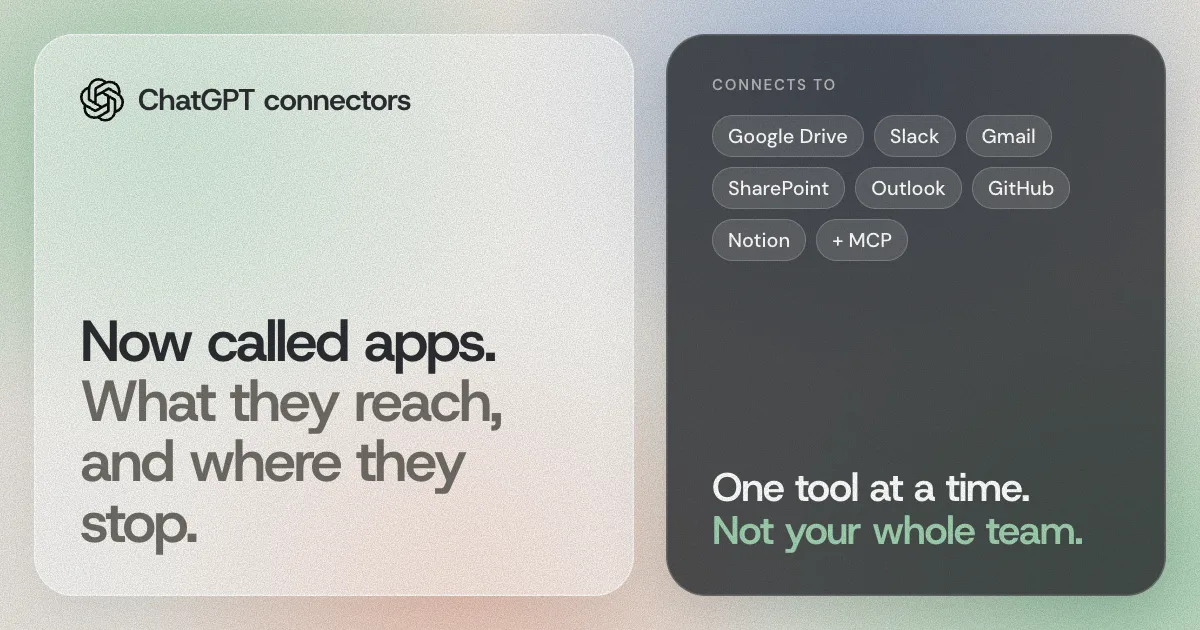
Yes. When you connect ChatGPT or Claude to Google Drive, Slack or a CRM, each person usually signs in with their own account, and the AI can only see what that account can see. Anthropic says Claude "inherits each person's permissions" from the connected service, and on Team and Enterprise plans each person still has to sign in individually after an owner turns a connector on. In ChatGPT, apps (once called connectors) now sit under Settings, then Plugins, and what's available depends on your plan, region, workspace, role and model.
An operations lead at a 20-person logistics company has connected the shared drive. A dispatcher hasn't connected anything. Both ask, "What's our late-delivery policy?" The ops lead gets the current policy document. The dispatcher gets a general answer about what late-delivery policies usually say, and it sounds just as confident.
The permissions are doing their job. The problem is that nobody has a full picture of who connected what, in which tool.
Do different AI models and plans give different answers?
Yes. Different models are trained differently, and even inside one product the model you get depends on your plan and settings. OpenAI's help center says the models and thinking levels available in ChatGPT depend on your plan and workspace settings, and new models roll out to some plans before others.
Models also change underneath you. OpenAI says outputs can shift because of "necessary changes OpenAI makes to model configurations," and its release notes list new models and changes regularly.
The founder of a 6-person online shop uses the newest model with longer thinking. Her part-time marketer, on a different plan, uses the default. They ask for the same product description and get different lengths, different tones and different claims. Agree which model to use for team work, and after a big update, rerun your shared prompts to check they still do what you expect.
What happens when the AI finds conflicting or out-of-date documents?
It picks one, and it may not pick the right one. An AI searching your files might find "Pricing 2025 FINAL," "Pricing 2026 draft" and a chat message saying prices changed last month. Nothing tells it which one your team agreed on. Two people asking the same question can get answers built from different versions.
An office manager at a 10-person dental practice asks for the cancellation fee. The AI quotes an old handbook PDF that's still sitting in the shared drive. The answer is accurate to that file and wrong for the practice.
The fix is one agreed source of truth per topic: one place for pricing, one for policies, one for each client's status. Archive old versions, or label them clearly, for example "old version, see Pricing 2026." It's dull work, and it fixes a whole class of wrong answers where they start.
Does web search change ChatGPT's answers?
Yes. With search, ChatGPT answers from current web pages and cites them. Without it, the model relies on what it learned in training and whatever you've connected. OpenAI says ChatGPT may search the web on its own when a question would benefit from current information, and in a managed workspace an admin can decide whether search is on for each role.
A sales rep at a 9-person software reseller asks about a competitor's pricing and gets an answer citing their site from this week. His manager asks in a chat where no search ran and gets an older figure from training. Decide when web results are welcome, like market research and news, and when only company sources count, like your own prices and policies. Then put that in the shared instructions.
How can a team get consistent answers from AI?
Share what the AI works from, then check what matters. In order:
- Write shared instructions. A short block everyone adds to their custom instructions or project instructions: who the company is, which sources to trust, and to say "I'm not sure" instead of guessing.
- Use shared projects for shared work. OpenAI says project sharing is available on every ChatGPT plan, and a shared project can draw on its chats, files and instructions. Claude projects can be shared on Team and Enterprise plans.
- Agree one source of truth per topic, and write down where each one lives.
- Clean up stale documents. Archive, delete or label old versions so they stop showing up in answers.
- Save prompts for the questions your team asks every week.
- Check the answers that matter. Anything going to a client, anything with a number in it, anything legal. Our AI policy guide for small teams uses the same rule.
- Put a shared context layer under the tools. With more than one AI tool, steps 1 to 5 get repeated in each tool, for each person. A context layer is one shared source of company knowledge every AI tool reads from, so the inputs stay the same whoever asks and wherever.
For a 12-person agency, a realistic first week is steps 1, 3 and 6: one shared instruction block, a one-page list of where the truth lives for pricing, policies and client status, and a rule that client-facing numbers get checked. If ChatGPT is where most of the work happens, see how to give ChatGPT your company knowledge.
Can you make AI give the same answer every time?
No, and you wouldn't want to everywhere. Sampling stays, whatever you do. For ideas, headlines and first drafts, getting something different each time is useful.
The honest trade-off is upkeep. The more consistent you want answers to be, the more someone has to maintain: shared instructions go out of date, each source of truth needs an owner, and a shared context layer is one more system to keep connected. That's worth it for facts that have to be right, like prices, policies and client status. For brainstorming, it usually isn't.
How AgentOS fits
The fixes above work inside one tool. The hard part is keeping them the same across every AI tool your team uses, for every person.
AgentOS sits underneath those tools. You connect your email, chat, files, calendar and CRM once, and ChatGPT, Claude, Cursor and your own agents connect over MCP and work from the same company knowledge. You choose what each AI tool can see, and anything that goes out, like an email to a client, waits for a person to approve it. You can also describe recurring work in plain language, such as a Friday client recap.
It won't stop a model from sampling, and it won't decide which of two conflicting documents is the right one. Your team still has to agree on that. What it does is make sure everyone's AI starts from the same place. More on what AgentOS is.
Questions people ask
Why does ChatGPT give a different answer when I regenerate?
Because it writes each answer fresh. A language model picks every word from several likely options, a process called sampling, so running the same request again can take a different path and land on a different wording or even a different conclusion.
Does ChatGPT give the same answers to everyone?
No. Each person's ChatGPT can draw on their own memory, custom instructions, projects and connected apps, and people may be on different plans or models. Even two identical requests can differ, because the model samples its words.
Does setting temperature to 0 make AI answers consistent?
Not fully. OpenAI describes its Chat Completions API as non-deterministic by default, and Anthropic says Claude's results are not fully deterministic even at a temperature of 0. Anthropic's API version dated October 21, 2026 removes the temperature setting altogether.
Which AI answer should I trust when two disagree?
The one you can trace to a source you trust. Ask the AI where the answer came from, open that source, and check it's the current version. If neither answer points to a source, treat both as drafts.
Does Claude give different answers than ChatGPT?
Yes. They are different models from different companies, trained in different ways, and each person's Claude has its own memory, projects and connectors too. Expect different wording and sometimes different conclusions.
Why did ChatGPT's answers change after an update?
Models and their settings get updated. OpenAI notes that changes it makes to model configurations can change outputs, and new models roll out to some plans before others. Rerun your team's shared prompts after a big update.
How do I get my team consistent answers from AI?
Share the inputs: one set of instructions, shared projects for shared work, one agreed source of truth per topic, old documents cleaned up, and saved prompts for common questions. Check answers that matter. If your team uses more than one AI tool, a shared context layer keeps those inputs the same across all of them.
Connect the tools your team already works in, then ask ChatGPT and Claude the same question about your business.
Try AgentOSSources
- OpenAI API reference: chat completions (temperature)
- OpenAI API docs: advanced usage, reproducible outputs
- Claude docs: glossary (temperature)
- Claude docs: API versions (2026-10-21)
- Thinking Machines Lab: defeating nondeterminism in LLM inference (September 2025)
- OpenAI help: memory in ChatGPT
- OpenAI help: projects in ChatGPT
- OpenAI help: connected apps in ChatGPT
- OpenAI help: GPT-6 and other models in ChatGPT
- OpenAI help: searching the web with ChatGPT
- OpenAI help: ChatGPT release notes
- Claude help: chat search and memory
- Claude help: what are projects?
- Claude help: use connectors
- AgentOS: what is a context layer?
AgentOS is built by Devcore. Found something out of date on this page? Tell us at tryagentos.net and we'll fix it.